


An Overview of the New Student Loan Program
College financing has entered into a new chapter. As of July 1, 2026, parents and students now face tighter borrowing limits and only two repayment options. These changes simplify parts of the program, but they also make planning more important than ever because loan availability, borrower responsibility, and future cash flow are all impacted. This blog will outline what these changes are, who they impact as well as provide some general information for those new to the process. In order take out Federal student loans, parents need to submit a FAFSA (Free Application for Federal Student Aid) at StudentAid.gov in the fall before the upcoming academic year.
New borrowing limits
Depending on who the borrower is, there are annual limits and total limits that can be borrowed for U.S. federal student loans. In general, borrowers fall into one of three categories: Parent, graduate/professional student and undergraduate. The table below summarizes what these limits are for each borrower and notes any change based on the new rules.
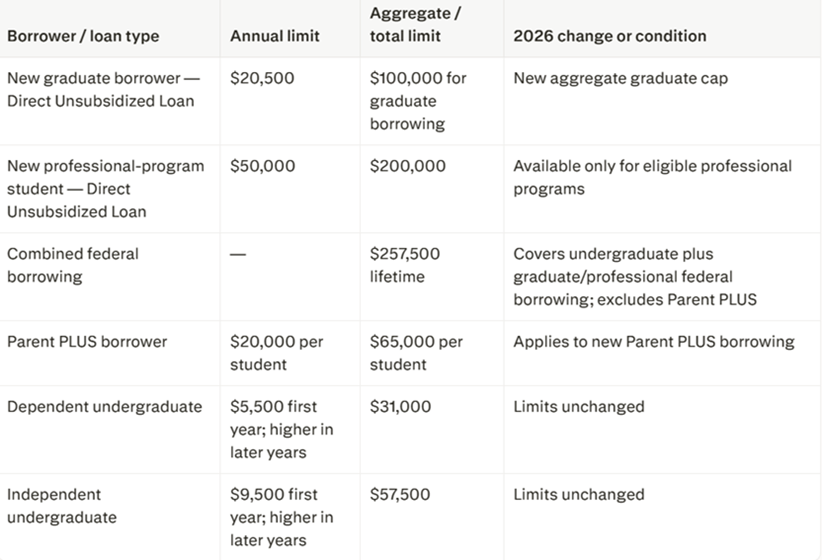
Whether you are new to the program or an existing borrow, some of these changes are important to note as they can have a big impact on available financing and the money coming out of your pocket.
For parents wanting to help pay for education, instead of being able to borrow the full cost of tuition they are now capped at $20,000/yr per student up to $65,000 total. This forces families to really access how much they can afford versus relying on Parent PLUS debt.
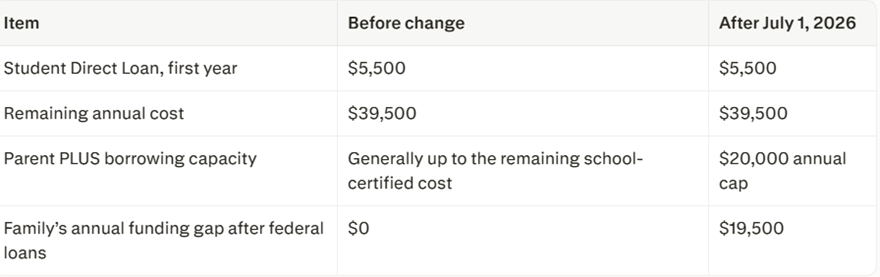
To illustrate this, below is a table showing available financing before the change versus after for a dependent undergraduate student enrolled in a school with an annual cost of $45,000. Previously, the family could rely on a Parent PLUS loan to make up the difference in costs after the student loan. Now, they are capped at $20,000/yr and must come up with the $19,500/yr difference from other sources.
For graduate students, the borrowing limit remains the same at $20,500/yr. However, the overall cap has been reduced from $138,500 to $100,000. Certain designated professional programs such as law and medicine can borrow up to $50,000/yr with a $200,000 cap, but the fields included in this are potentially narrowing.
For undergraduates, annual and total borrowing limits remain unchanged. However, the repayment plan options have limited which we will discuss later.
Interest rates on new loans
Another important number to be aware of is the interest rate you’ll be charged on the amount borrowed. For new U.S. federal student loans issued from July 1, 2026 through June 30, 2027 the fixed interest rates are as follows:
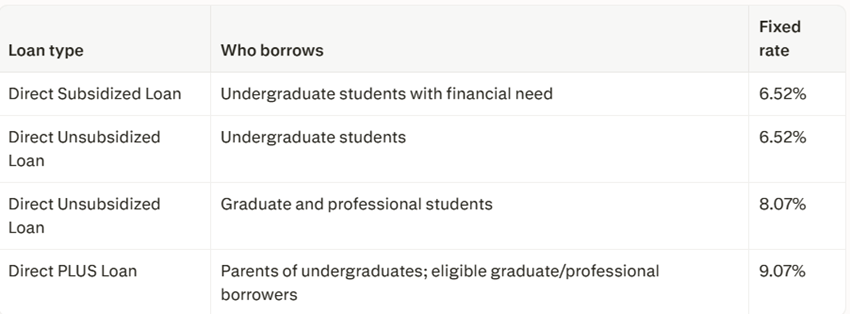
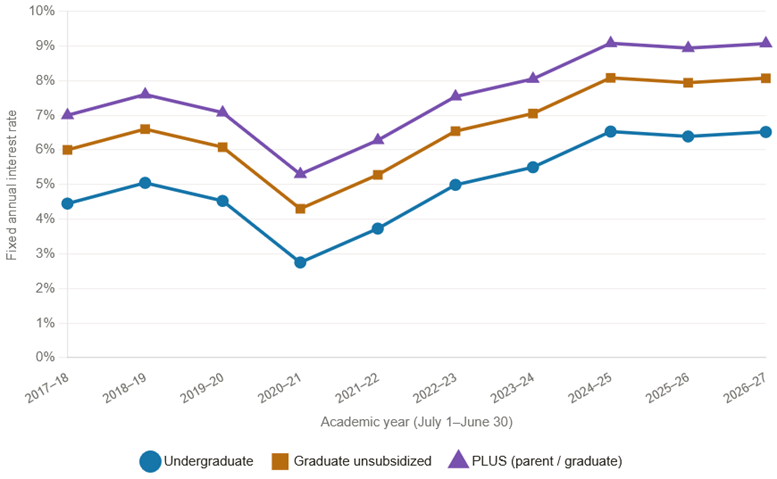
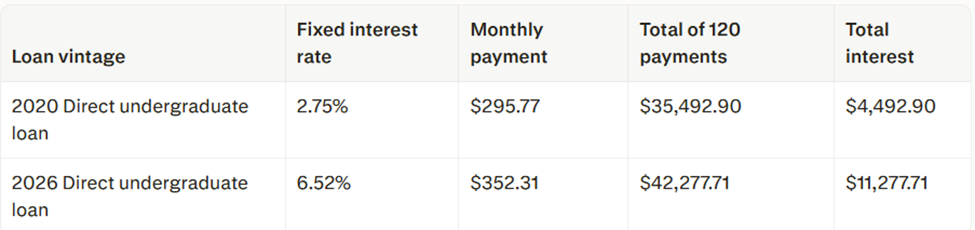
These rates are fixed for each loan’s lifetime, but rates may change for new loans issued in later years. The graph below shows the change in rates over the last 10 year rates. A student who took out a loan in 2020 only had a 2.75% fixed rate compared to a student today who is taking out a loan at 6.52%.
It’s also worth understanding and being aware of what the difference in monthly payment is for different rates due to higher interest. Assuming a $31,000 loan using a standard 10-year repayment term (120 monthly payments), the estimated payments for the two different rates referenced above would be as follows:
For borrowers needing to access the private student loan market, rates can vary depending on certain factors such as credit scores and income. They can also have variable pricing instead of a fixed rate like federal loans.
Changes to Repayment Options
After finalizing how much a student qualifies for, they will then need to analyze and choose a plan for how they will repay that borrowed amount. Income, household size, tax filing status, career stability, other debt, and potential forgiveness eligibility all can impact which repayment plan is the best. Choices have now been narrowed down to two options: the new Tiered Standard Plan and the Repayment Assistance Plan, or RAP, which are summarized below.
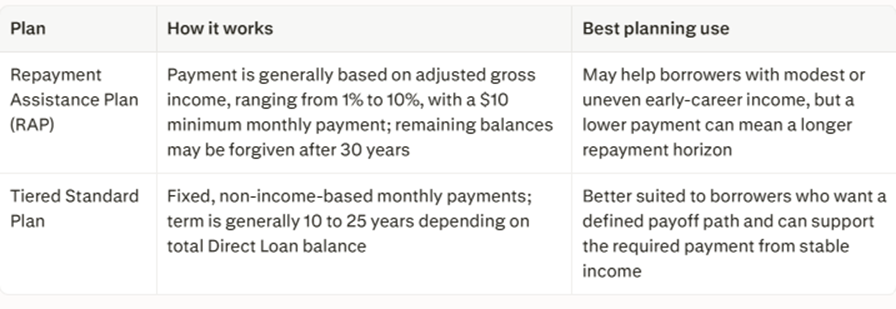
It is worth noting that existing borrowers should not assume their current repayment plan will remain available or yield the same result once these changes are fully implemented. Because consolidating a federal loan may also affect repayment-plan eligibility and forgiveness strategies, borrowers should evaluate the consequences before proceeding.
The funding gap and why planning matters
While these program changes are designed to help control rising college costs, families will need to pay much closer attention to each school’s total price so they know and can plan for how they will cover any shortfall. In the past, Parent PLUS loans could serve as an unlimited backstop, and graduate students could use Grad PLUS loans to fill funding gaps. Going forward, if a program’s cost exceeds the new borrowing limits, families should carefully review their options—such as scholarships, personal savings, payment plans, a lower-cost school, or private borrowing—BEFORE committing to a program so they know exactly how much they are responsible for and how it will impact their goals. For those with younger children, this is another reason to start saving early as those 529 balances can compound over time and help with that potential funding gap down the road.
Sources: Perplexity, WSJ
Have questions? Reach out! We're happy to help.
Posted by Kirk, a fee-only financial advisor who looks at your complete financial picture through the lens of a multi-disciplined, credentialed professional. www.pvwealthmgt.com