


Key Tax Documents and Remaining Tax Moves for 2025
Here is my updated blog post to help during this tax season. Some have already gathered the necessary documents for their accountant while others are putting it off - for now. This blog post is broken into three sections:
- High level overview of income types and the tax rates that apply
- Last minute tax planning moves for 2025 tax year – yes, still time for some
- Common tax documents to provide accountant and information contained – including some new ones due to OBBBA and Form 1099-DA if hold crypto directly.
Please note this is not formal tax advice. I am not an accountant, nor do I prepare tax returns. But as a financial planner, I understand these topics very well and perform detailed tax planning for our clients during the year to give them more control and minimize tax surprises. Reach out if that sounds appealing.
Section 1 - High level overview of income types and tax rates that apply
Income can be generated from many different sources. Which tax form captures that income and whether related taxes are withheld during the year are summarized in the following table.
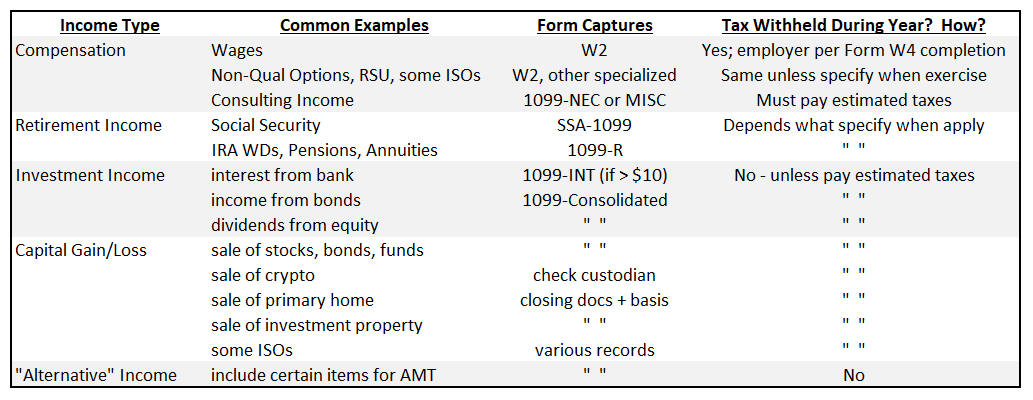
Income is classified into two major categories - ‘ordinary income’ or ‘capital gains’. Note that ‘capital gains’ if held one year or less is taxed as ‘ordinary income’. There are further nuanced definitions of income, including multiple versions of “Modified Adjusted Gross Income (MAGI)” used for different deduction purposes. I won’t get into the details here, but one key MAGI to be aware of if 65+ the one used for Medicare premium surcharge – called IRMAA. That version of MAGI = Adjusted Gross Income + tax-exempt interest is compared against different bands for potential extra premiums.
Next a series of offsets are applied which can reduce the amount of income that is taxable. Some common examples are listed but many rules govern whether a taxpayer qualifies – IRA/HSA contributions; student loan interest; self-employed FICA/Qualified Plans/Insurance; capital loss carry-forward; itemized or standard deduction; QBI; etc. The net amount after these offsets is called ‘taxable income’. This is on Line 15 of Form 1040 for those following along at home. NOTE - OBBBA may allow more individuals to itemize deductions in 2025 (see Section 3).
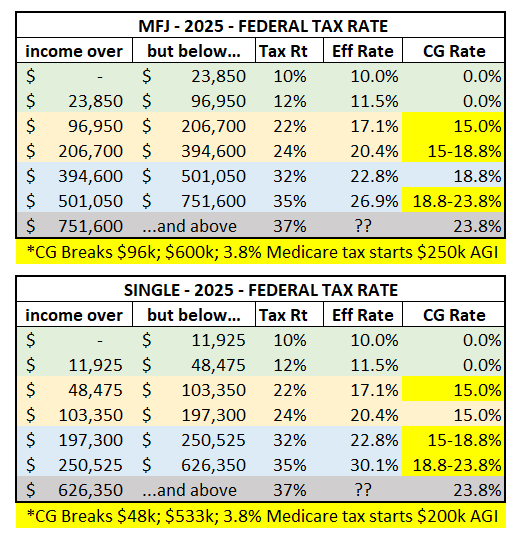
Note this total ‘taxable income’ is misleading because different tax rates apply depending on the portion that is ‘ordinary income’ vs. ‘capital gains’ (technically just long-term gains). The tables below summarize which marginal tax rate applies depending on income levels. There is an additional 3.8% Medicare tax applicable to ‘investment income’ which is a combination of both ordinary and capital gains. Fun stuff!
Section 2 - Last-minute tax planning moves for 2025 Tax Year
Now that we clarified income types and which tax rates apply, you may be motivated to take action that could reduce ‘taxable income’. Ideally you are doing this throughout the year when there are more options, but there is still time for a few contributions to qualified accounts that impact the 2025 tax year. And while there is nothing directly you can do to change ‘capital gains’, by reducing ‘ordinary income’ you can possibly reduce the tax rate that applies to some of the ‘capital gains’ – even down to 0%!
IRA Contributions
- Allowed to make 2025 tax year contributions up to tax filing deadline; can NOT rely on extension date
- Everyone with taxable compensation is allowed to contribute to an IRA
- Spouses can rely on spouse’s income if not enough of own
- Even if participate in employer’s 401k/403b, can still contribute to IRA provided enough taxable compensation on W2
- However, the amount deductible for a Traditional IRA and if eligible for Roth IRA can be limited based on Modified Adjusted Gross Income and other factors
- Depending on circumstances, a backdoor Roth may be attractive
- Roth IRA activity won’t reduce taxable income this year but all future investment income is tax-free provided follow the age 59.5 withdrawal rules
- Maximum contribution for 2025 tax year is lesser of eligible taxable compensation or $7,000; extra $1,000 catch-up if 50 or older
- Many miss out on IRA contribution opportunities; call for help to get what is yours
Health Savings Account (HSA) Contributions
- Allowed to make 2025 tax year contributions up to tax filing deadline
- Anyone with a qualified High Deductible Health Plan (HDHP) is allowed to make tax-deductible contributions to an HSA, regardless of income
- Check with insurance provider if your medical insurance is HDHP
- Maximum contribution for 2025 tax year is $4,300 for single plan, $8,550 for family; $1,000 catch-up if 55 or older (not 50 like IRAs) and have own HSA account
- If participate through work and payroll deduction but fell short of maximums, can contribute directly into HSA account – contact the HSA custodian
Some 529 College Savings Plans
- Contributions for most states must be in by 12/31 of the tax year to be deductible
- A few states allow contributions for 2025 tax year up to tax filing deadline
- Verify with your state but in the past the following apply – GA, IN, IA, KS, MS, OK, SC, WI
Employer-related Retirement Plan Contributions
- While the employee-related contribution deadline has passed, employers can still make a tax-deductible contribution up to their tax filing deadline, including extensions (3/15 corporation, 4/15 LLCs, Sole Prop)
- If you own a business, depending on type of retirement plan you have (if any), may be eligible to make deductible contribution
- Rules can get complicated depending on the plan and type of income so reach out to a professional for help
Section 3 - Common tax documents needed for accountant and information contained
W2
- Wages and compensation received from employer along with tax withholdings already paid for the tax year
- Any tax-deductible 401k/403b, Health Savings Accounts (HSA) and Flexible Spending Accounts (FSA) contributions made via payroll are netted out of “box 1” wages
- If you have company stock options or grants be careful; look for additional documents
SSA-1099
- Social Security benefits received for the tax year
- Shows gross Social Security benefits before Medicare premiums or taxes (if any) are withheld
- The amount taxable depends on ‘provisional income’ definition; can be as low as 0% or as high as 85%
1099-NEC or MISC
- Income received in 2025 in excess of $600 from non-employer sources
1099 INT and Consolidated
- Related to non-qualified investment accounts; will NOT receive one for IRAs
- Taxable income related to securities held and or traded in particular account
- Dividend income – both qualified (taxed like long-term gains) and ordinary
- Interest income – both taxable and tax-exempt (like Muni’s); also watch for interest from Treasury-related bonds that may be exempt from state tax
- Capital gains – both short-term (< 1 year taxed liked ordinary) and long-term
- Pay close attention to items classified as ‘non-covered’ and make sure cost basis correct
1099-R
- Gross distribution and any tax withholdings from all types of IRAs (including inherited) and 401k accounts
- Will receive separate form from each account where withdrawal occurred
- Contains an IRS distribution code which determines how treated on tax return
- If you are over Required Minimum Distribution (RMD) age and have a Traditional or 401k account you should have one!
- Few key things to note:
- “Direct transfer” between qualified accounts generates 1099-R but not taxable
- Withdrawal from Traditional IRA for Roth conversion may say ‘taxable’ but in some circumstances, some or all may not be taxable using Form 8606
- Any Qualified Charitable Distribution (QCD) DO NOT SHOW ON 1099-R; YOU MUST KEEP TRACK AND TELL YOUR ACCOUNTANT (starting in ’25 it is optional – and ’26 mandatory – for custodian to add distribution code Y for QCD)
Form 5498
- Contributions, transfers and conversions coming into IRA accounts
- Because contributions allowed up to tax filing (see earlier), form not available until May
- Check online at custodian or use year-end and latest monthly account statements to show contributions by tax year
- Note some contributions in a given calendar year may apply to previous tax year
Form 1099-SA
- Gross distribution from Health Savings Account (HSA)
- Provided distribution to cover a qualified medical expense, not taxable
- You must keep track of cumulative qualified medical expenses and withdrawals
- Unlike IRAs, you will NOT receive this form for HSA-to-HSA transfer
Form 5498-SA
- Similar to 5498 for IRAs but this applies to contributions (not transfers) into Health Savings Accounts (HSAs)
- Check online or rely on statements until May; verify which tax-year contributions apply
Donor Advised Fund (DAF) Contributions
- Typically available on annual DAF account summary statement
- Full value deductible in year of contribution; no deduction when later distribute to different charities
- Cash contribution or if donated securities, the market value on date of contribution to the DAF PROVIDED IN LONG-TERM GAIN STATUS
- There is no tax-related form for withdrawals since full deduction when contribute
Form 1099-Q
- Gross distribution from qualified education savings account like a 529
- You must keep track of qualified educational expenses – either from school or other
- The school should issue 1098-T showing tuition expense; you must handle other qualified expenses like room/board if living off-campus or computer equipment, etc.
529 Plan Contributions
- Rely on statements to track contributions into plan; recall only some states deductible
- Unlike IRAs, most states require contributions be made by 12/31 of a given tax year (see above for a few state exceptions)
- There is no Federal Tax deduction but some states allow state deduction, up to limits
- Another example where many people miss out on these tax benefits; call if need help
Form 1099-DA
- All taxpayers required a Yes/No at top of Form 1040 if involved with digital assets
- Note this is intended for transactions directly in crypto, not for crypto ETFs; those are handled on normal Form 1099 Consolidated
- If held digital assets directly, new this year is Form 1099-DA will receive (or should!) from crypto custodian if a taxable account (i.e. Coinbase, Kraken, Paxos, Gemini, etc)
- Be aware of difference between ‘gross proceeds’ of a sale and ‘taxable gains’ which involves ‘cost basis’
- Verify cost basis at custodian – especially if transferred in – and reported ‘taxable gains’ properly reflects your true ‘cost basis’
Potential new information to gather due to One Big Beautiful Bill Act (OBBBA)
- See my recent blog post for the key provisions
- Depending on income, may deduct up to $40k SALT so may need to provide itemize deduction info
- If part of income from qualified Tips or Overtime, check with accountant on how they need that information reported
There is one “tax” that is not reported to the IRS which is a good thing for parents with a sweet tooth - it is the Candy / Ice Cream tax from their child’s serving. Watch out kids!
Have questions? Reach out! We're happy to help.
Posted by Kirk, a fee-only financial advisor who looks at your complete financial picture through the lens of a multi-disciplined, credentialed professional. www.pvwealthmgt.com